
Why contract management feels harder than it should
If you speak to almost any experienced commercial leader in construction, you will hear a version of the same truth:
Contract management feels harder than it should.
The contracts themselves may be complex. The projects certainly are. But the day‑to‑day mechanics of administering notices, managing change, tracking programme and reporting cost ought to feel controlled and deliberate. Instead, they’re often a headache. Reactive. Manual. Tense.
Across asset owners, contractors and consultancies, the pattern is remarkably consistent. The difficulty is rarely about intelligence or commitment. It is usually about how the work is structured.
A hostile start
One of the first signs is subtle. The project atmosphere becomes slightly defensive.
Correspondence starts to feel like protection rather than collaboration. Teams focus on documenting positions rather than reducing risk together. People feel commercially and personally exposed because the evidence trail is incomplete or hard to locate.
For client teams, this often surfaces too late. Issues that should have been visible months earlier appear at payment stage or close‑out.
In one case, a client only understood the true scale of change exposure at final account because early warnings and change packs were stored in individual consultant and contractor folders rather than a shared client record. When the final account arrived, they could not clearly see what had been notified, what had been accepted, or which decisions had been made. Negotiation began without a clean line of sight.
For contractors, the pressure shows up differently. Notices slip because workflows are not fully embedded. Registers are updated after the event. Competence varies widely across the team, so performance depends heavily on one or two experienced individuals. Resilience and bandwidth are gradually eroded.
For consultancies acting as Project Manager or Commercial Manager, the strain appears as coordination effort. Chasing actions, evidence and approvals absorbs time that should be spent adding value. Decisions sit across emails, minutes and attachments, with no obvious single source of truth.
None of this is dramatic in isolation but collectively makes the project increasingly difficult to administer.
When everything is manual, everything feels urgent
Another reason contract management feels harder than it should is the sheer volume of manual handling.
At project level, reporting often relies on spreadsheets and email threads. Each month, teams rebuild the same reports. Data is copied, pasted, reformatted and reconciled. Definitions vary between packages. Source files live in different locations. Version control becomes a standing agenda item.
A simple example illustrates the impact.
A planner issued a revised programme following a design delay. The QS continued reporting against the previous accepted baseline because no one confirmed the formal change point. Forecast meetings began with screenshots and version checks rather than decisions. The issue was not capability. It was coordination and clarity.
When senior leaders cannot immediately see where the latest truth sits for notices, programme status or cost, the project remains reliant on individual effort rather than a repeatable process.
That reliance creates friction. It also creates risk.
Records go missing and surprises increase
Where routines are inconsistent, records get lost.
Templates differ between projects. Approval routes vary. Registers are maintained in slightly different formats. Data sits in multiple systems without clear ownership or definitions. Reporting depends on manual collation, often without strong auditability.
For asset owners, this means visibility arrives late. Reputational exposure increases because governance relies on patchwork evidence.
For contractors, it means time‑bar and process failures become more likely. Cashflow becomes less predictable. Teams spend time rebuilding the same reports instead of resolving issues early.
For consultancies, it can lead to manipulated numbers. Dashboards look polished but rely on manual manipulation behind the scenes. Arguments arise about the numbers themselves rather than the actions required.
Over time, everyone feels on the back foot. The project reacts to surprises rather than steering outcomes.
Data without shared definitions is not clarity
Many of these frustrations trace back to something deceptively simple: inconsistent data discipline.
It is common to find inconsistent naming conventions, missing unique identifiers, duplicated issues and unclear status definitions. Without agreed definitions and rules, teams spend time reconciling rather than deciding.
On one project, each package reported change and payment status differently. The QS spent hours each week aligning registers before any meaningful conversation could take place. When one template pack and one set of status definitions were enforced, the time saved was redirected towards chasing early warnings, agreeing actions and preventing escalation.
The work did not become lighter because it was automated. It became lighter because it was consistent.
When “digital” is treated as an IT project
Faced with these challenges, organisations often look first to software.
Technology absolutely has a role to play. However, one of the most common pitfalls is treating digital enablement purely as an IT initiative.
Early warning signs are familiar. Low governance attendance because people assume the system will fix behaviour. Feature lists dominate conversations while operating rhythm is ignored. User teams are not meaningfully involved in trials or selection. Data integration is discussed before core fields are defined.
In these scenarios, the system becomes another layer rather than a solution.
Digital tools can support discipline. They cannot create it in isolation.
The quiet complication of AI
A more recent layer of complexity is AI use.
In many environments, AI is already being used informally for drafting or analysis. In others, it is avoided entirely due to uncertainty. Without agreed guardrails, both approaches introduce risk.
Text may be generated and issued without adequate checking. Confidential information may be copied into tools without clarity on ownership or storage. Alternatively, valuable efficiencies are lost because teams are unsure what is acceptable.
What makes this feel harder is ambiguity. When there is no shared policy on approved uses, prohibited uses, confidentiality, checking and escalation, variability increases. So does exposure.
Clarity, not experimentation for its own sake, is what reduces friction here.
So why does it feel harder than it should?
When you step back, a pattern emerges.
Contract management feels harder than it should when it relies on individuals rather than a defined operating process. When templates and registers vary. When data is not defined. When evidence is scattered. When governance cadence is irregular. When tools are introduced without first agreeing how the team will work.
It becomes heavy because too much effort is spent reconciling, checking and defending, and not enough on deciding and steering.
Importantly, none of this requires perfection to improve.
Introducing structure without over‑engineering
This is where a structured adoption framework becomes helpful.
The Contract Wedge provides a practical route for moving from reliance on traditional tools towards digitally enabled delivery in a controlled way. Rather than aiming immediately for full integration or automation, it focuses on what needs to be consistent at project level first.
Its visual diagram represents progression from Level 1, where effort is high and control depends heavily on individuals, towards Level 2, where ways of working are standardised and repeatable. The wedge widens as clarity increases across people, process, data and governance.
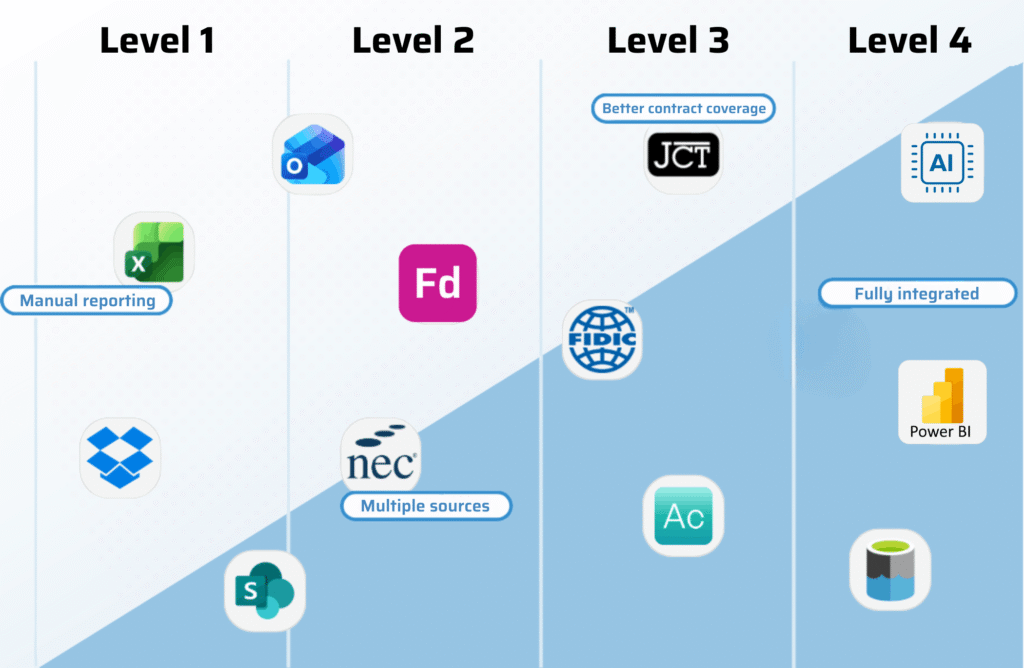
A basic mock-up of the contract wedge.
At Level 2, manual collation may still exist, but it is controlled and auditable. A minimum dataset for contract administration is defined. A data audit clarifies what exists, where it sits and what quality issues are present. A data dictionary sets naming rules, allowed values and unique identifiers. Meeting cadence and governance rhythms are explicit. Roles and decision rights are clear. An AI use policy is scoped, published and trained.
Digital systems, whether through standardised proformas or a contract management system such as FastDraft with configurable workflows and communication logs, are configured to support these behaviours rather than replace them.
The emphasis is pragmatic. Standardise first. Enable digitally second.
What changes when it becomes repeatable
When this structure is in place, the shift is noticeable.
For clients, issues surface earlier while options remain open. Governance becomes calmer because records and audit trails are easier to trace. The organisation becomes a more predictable and attractive client to its supply chain.
For contractors, defined workflows reduce missed steps and time‑bar risk. Clear ownership reduces confusion. Standard definitions reduce duplication and the monthly reporting grind.
For consultancies, a clear operating rhythm reduces friction. Decisions and notices are easier to locate, check and defend. Assurance checks replace reactive evidence hunts.
Collectively, meetings move from status updates to decision points. Data tells a consistent story. Trust begins to rebuild.
Contract management does not become simple. It becomes steadier.
A practical next step
If contract management feels heavier than it should on your projects, it may not be a question of working harder or buying more features.
It may be about agreeing how the team works, evidencing it, and then enabling it consistently.
The Contract Wedge Playbook sets out the practical methodology, checklists and evidence required to move from traditional reliance on manual tools towards a digitally enabled, repeatable operating model. It is designed for clients, contractors and consultancies alike, and focuses on achievable Level 2 control rather than over‑promised transformation.
If you would like to assess where your projects currently sit, and what a controlled transition could look like, download the Contract Wedge Playbook and begin with clarity rather than complexity.

by Genna Rourke BSc (Hons) LLM MSc MRICS FCInstCES NECReg CQP MCQI
Genna joined us in January 2026 as our Industry Engagement Director to strengthen BI’s connection with industry, ensuring our products, training, and insights are shaped by real-world challenges and the needs of the construction professionals using them. In this role, she will lead strategic engagement across customers, partners, and industry bodies, helping translate industry insight into practical value.
With over 20 years’ experience in construction, progressing from Quantity Surveyor through to Commercial Director, Genna brings deep, practical industry insight across the commercial lifecycle of projects. Her background gives her a clear understanding of the pressures faced on live projects and how digital tools, training, and better processes can genuinely add value.

Why I Joined Built Intelligence and What I’ll Be Writing About
Genna Rourke joined Built Intelligence as Industry Engagement Director in January 2026. With nearly twenty years’ experience across quantity surveying and commercial leadership, Genna brings first-hand industry perspective to our work across FastDraft, Academy and wider thought leadership. In this new series, she will share practical views on the challenges construction teams face in contract management, capability development and commercial control. Hello. Here’s who I am and why I’m writing. I joined Built Intelligence in January 2026 as Industry Engagement Director. Before that, I spent nearly twenty years working as a quantity surveyor and commercial leader across infrastructure, civil engineering and contractor environments. I am a Chartered QS, MRICS and FCInstCES,...
FastDraft: Setting up NEC contracts for success
The early days of an NEC contract set the tone for everything that follows. Yet, on many projects, the first 90 days are where discipline slips, processes drift, and risk quietly builds. Teams attend training. They understand the contract. They start with good intentions. But as delivery pressures increase, the gap between what people know and what they actually do begins to widen. That gap is where projects lose control. FastDraft closes it. By embedding structure, prompts and accountability directly into the workflow, it turns NEC knowledge into consistent, repeatable behaviour from day one. Behaviour vs documentation NEC contracts are designed around proactive management, clear communication and strict timescales. Success depends less on what is written and more on how...

5 things you need to do in the first 90 days of your NEC Contract
When it comes to NEC contracts, the first few weeks of a project set the tone for the entire delivery. Many disputes, delays, and unnecessary costs originate not from technical complexity but from overlooked processes, unclear roles, and poor documentation right at the start. NEC4 is designed for proactive management. If you treat it like a traditional contract and “sort it out later”, you risk compounding small issues into major problems.Small Mistakes, Big Consequences Early inconsistencies in NEC4 contracts can escalate quickly. Common examples include: Incomplete Contract Data – Missing dates, unclear roles, or unvalidated options can cause confusion when a time-critical decision arises. Uncoordinated Scope / Works Information – Ambiguities in what needs delivering often surface as...