
Contractor spotlight: Why 96% would recommend FastDraft
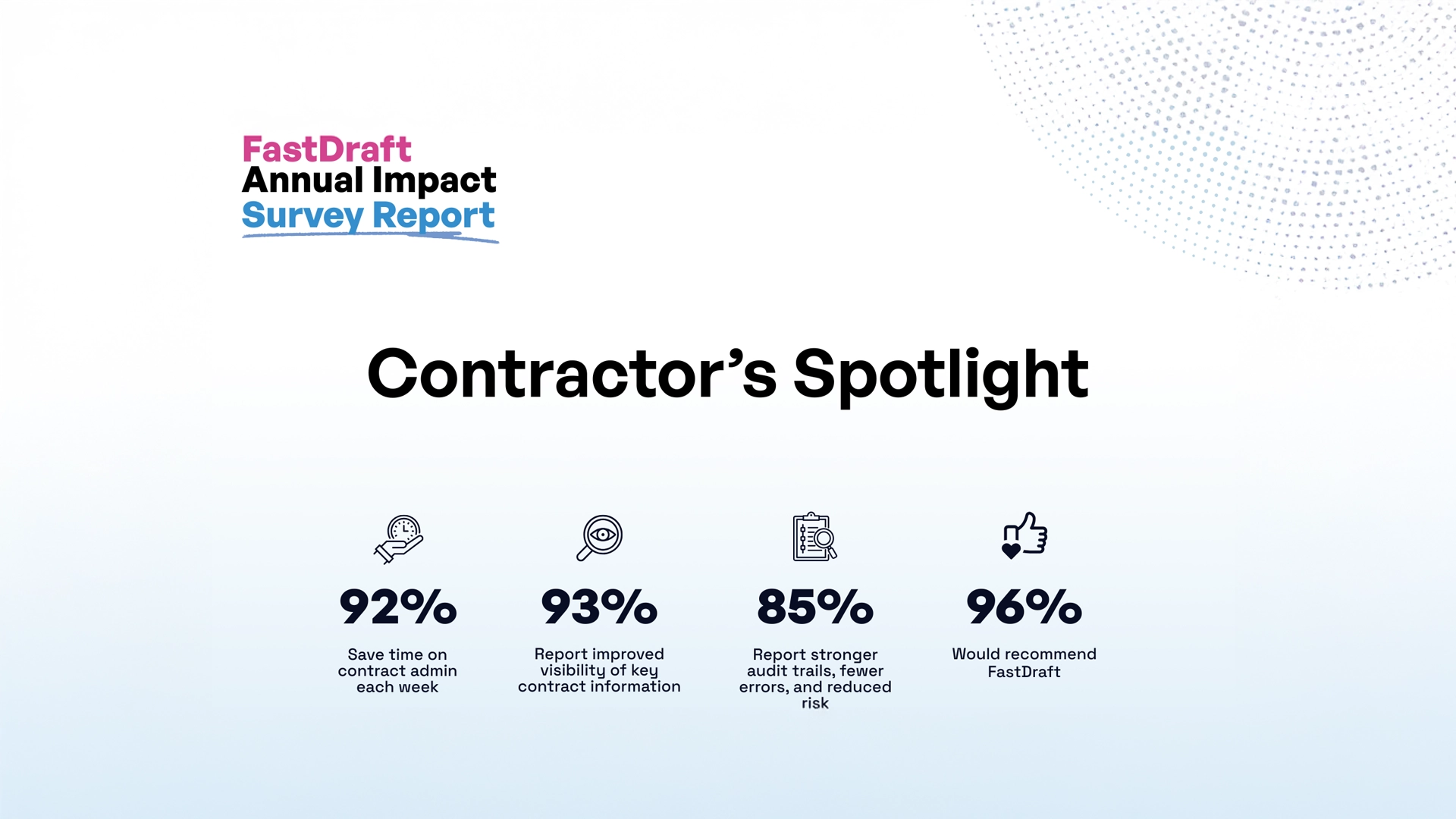
FastDraft’s 2025 Impact Survey shows 96% of contractors would recommend the platform to peers to improve their construction contract management. Here’s why contractors are finding it easier to save time, stay ahead of deadlines, and keep audit-ready records.
Saving hours each week on contract admin
Contractors know the grind: scrolling through inboxes for critical notices, juggling multiple spreadsheets to track changes, or raising notices without standardised templates. Add in chasing delivery partners at crunch times, and it’s no wonder admin consumes hours that should be spent on delivery.
FastDraft changes that. In our 2025 Impact Survey:
- 92% of contractors reported saving time each week with FastDraft
- Work that once took hours of manual effort now takes minutes thanks to structured forms, standardised templates, and centralised registers
- Reducing rework is a major benefit, as teams spend less time correcting errors or re-entering missing details
The result? Less time wasted, less frustration, and more focus on moving projects forward.
Tracking deadlines, change events and notices in one place
Deadlines, compensation events, and change notices don’t just need to be logged, they need to be tracked proactively to keep programmes on course. For contractors relying on several ever-changing spreadsheets, staying ahead often means chasing people down blind alleys for information, or reacting late when issues surface.
FastDraft gives teams a clearer way forward. With:
- 92% of contractors reporting improved visibility of notices and deadlines
- Automated reminders that surface upcoming risks before they escalate
- A single source of truth for deadlines, notices, and change events
That clearer oversight across multiple projects helps contractors spot risks earlier, reduce stress, and keep programmes on track.
Audit-ready, without chasing paper trails
Audit trails have long been a pain point: fragmented emails, missing attachments, and incomplete records make it hard to prove who did what, and when.
FastDraft makes it simple. 85% of contractors report stronger audit trails and record-keeping, thanks to:
- Every notice and response logged with date and time stamps
- One consistent record that’s always audit-ready
- Reports that can be shared instantly with clients and supply chain
For contractors, that means better control, fewer disputes, and stronger commercial outcomes, with the confidence that their records will stand up to scrutiny.
What contractors say
The stats are strong, but the lived experience is just as powerful. Here’s how surveyed contractors describe the difference FastDraft makes:
“FastDraft saves time daily by managing complicated contract documents more efficiently.” Quantity Surveyor, Balfour Beatty
“It’s easy to use and reduces time spent drafting and sending communications.” Construction Manager, Kier
“It’s simple and efficient. Excellent for raising / tracking notifications.” Senior Quantity Surveyor, Walters Group
The takeaway
Contractors face intense pressure to deliver on time, on budget, and with full accountability.
FastDraft is helping them cut down on admin, gain visibility of deadlines, reduce rework, and maintain strong audit trails – all while protecting margins and delivering clearer oversight across multiple projects.
With 96% of contractors saying they would recommend FastDraft, the message is clear: the platform is delivering real results where contractors need them most.
👉 Start the Demo Tour to see the workflows in action.
👉 Or Download the Full Report for a deeper dive into the contractor findings

Why I Joined Built Intelligence and What I’ll Be Writing About
Genna Rourke joined Built Intelligence as Industry Engagement Director in January 2026. With nearly twenty years’ experience across quantity surveying and commercial leadership, Genna brings first-hand industry perspective to our work across FastDraft, Academy and wider thought leadership. In this new series, she will share practical views on the challenges construction teams face in contract management, capability development and commercial control. Hello. Here’s who I am and why I’m writing. I joined Built Intelligence in January 2026 as Industry Engagement Director. Before that, I spent nearly twenty years working as a quantity surveyor and commercial leader across infrastructure, civil engineering and contractor environments. I am a Chartered QS, MRICS and FCInstCES,...
FastDraft: Setting up NEC contracts for success
The early days of an NEC contract set the tone for everything that follows. Yet, on many projects, the first 90 days are where discipline slips, processes drift, and risk quietly builds. Teams attend training. They understand the contract. They start with good intentions. But as delivery pressures increase, the gap between what people know and what they actually do begins to widen. That gap is where projects lose control. FastDraft closes it. By embedding structure, prompts and accountability directly into the workflow, it turns NEC knowledge into consistent, repeatable behaviour from day one. Behaviour vs documentation NEC contracts are designed around proactive management, clear communication and strict timescales. Success depends less on what is written and more on how...

5 things you need to do in the first 90 days of your NEC Contract
When it comes to NEC contracts, the first few weeks of a project set the tone for the entire delivery. Many disputes, delays, and unnecessary costs originate not from technical complexity but from overlooked processes, unclear roles, and poor documentation right at the start. NEC4 is designed for proactive management. If you treat it like a traditional contract and “sort it out later”, you risk compounding small issues into major problems.Small Mistakes, Big Consequences Early inconsistencies in NEC4 contracts can escalate quickly. Common examples include: Incomplete Contract Data – Missing dates, unclear roles, or unvalidated options can cause confusion when a time-critical decision arises. Uncoordinated Scope / Works Information – Ambiguities in what needs delivering often surface as...