
Contract Wedge Level 2: What Digitally Enabled Looks Like
It suggests integration programmes, automation roadmaps and enterprise transformation. Something large, expensive, and potentially disruptive.
Contract Wedge Level 2 is much more practical than that.
Level 2 isn’t about automation or digitisation for its own sake, but about putting enough structure in place so that contract data is consistent, visible and usable.
It’s about moving away from traditional, spreadsheet-led administration towards a repeatable way of working, supported by the right tools.
What getting to Level 2 actually means
At Level 1, projects rely heavily on spreadsheets, email chains and personal discipline. Templates vary; registers are inconsistent; reporting is manually rebuilt; evidence sits in multiple folders; and AI is used informally if at all. By getting to Level 2, you don’t have to eliminate manual processes completely.
Instead, Level 2 on the contract wedge introduces consistency across four areas: people, process, data and governance. In practical terms, getting there means:
- Running a repeatable contract management operating process, including agreed communication templates, governance cadence and audit logs.
- Using consistent proformas and controls through either structured online forms or a contract management system.
- Defining a minimum dataset for contract administration and reporting, supported by a data dictionary with clear field definitions, naming rules and unique IDs.
- Completing a scoped data audit and producing a Level 2-sized migration plan focused on essential records first.
- Publishing and embedding a usable AI policy covering approved uses, prohibited uses, confidentiality, checking and escalation.
None of this needs enterprise-wide automation as a pre-requisite.
Manual processes are still allowed at Level 2 – they just need to be implemented in a controlled and auditable way. The shift may seem subtle, but it’s a powerful one that allows contract management to become predictable across teams & projects.
Adopting a CMS like FastDraft can help with the initial stages of Level 2 adoption by providing a system that does exactly that – makes contract management more controlled and auditable.
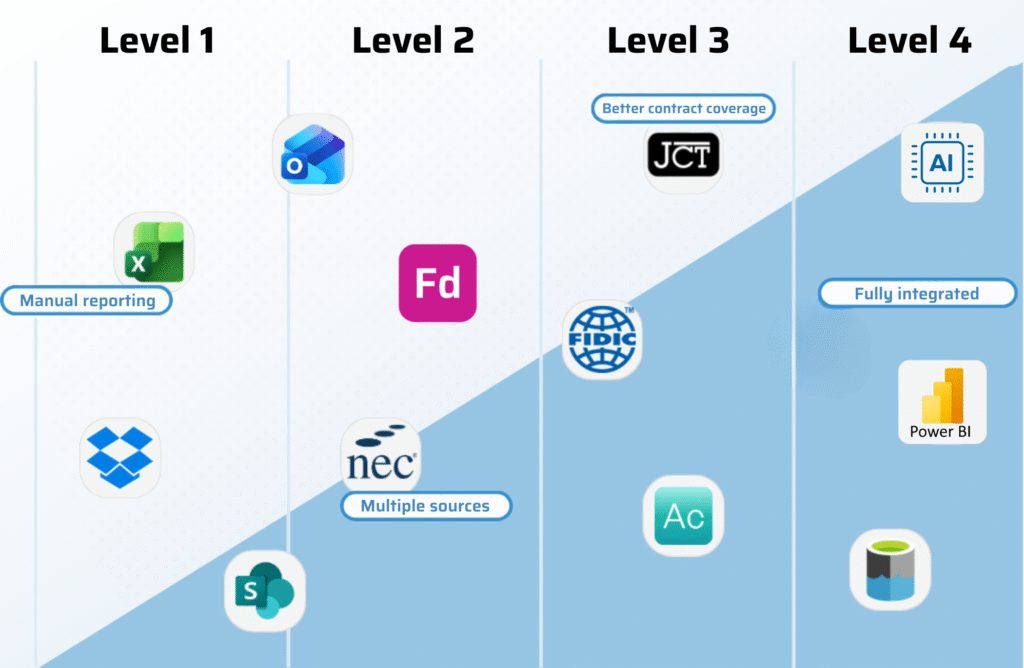
A basic mock-up of the contract wedge.
What Level 2 delivers for Asset Owners
For Asset Owner leadership teams, Level 2 changes visibility first and foremost. Issues begin to surface earlier with notices, risks and change events being tracked through consistent workflows.
Governance meetings move from retrospective reporting and fire-fighting to decision points that look forward instead of back. Audit trails become traceable, and you can be assured that teams are storing communications correctly.
A Level 2 data audit clarifies what data exists, where it lives and what shape it’s in. This doesn’t promise a single integrated source of truth immediately. It provides a foundation for one. In this sense, it’s clearly not about achieving perfection. But rather enabling earlier intervention while options on where to build next remain open. That shift alone can be huge in reducing reputational exposure and governance stress.
Through using standardised systems like a CMS, owners also stand to make their clients more predictable counterparties. Standard templates and registers like those offered in FastDraft trickle down to better management from the supply chain.
What Level 2 delivers for Contractors
For Contractors, the main impact of Level 2 is operational.
Defined workflows reduce time-bar and process failures. Clear role ownership reduces confusion over who is responsible for notices and responses. Standard definitions across packages reduce duplication and reporting grind. A minimum dataset and enforced data dictionary improve trust in the numbers. When reporting is built on consistent fields and validation, reconciliation effort reduces.
Using a CMS such as FastDraft can support this discipline by embedding workflows, role permissions and communication logs into day-to-day activity. The system becomes a guardrail rather than an additional layer of administration. The result is fewer missed steps, stronger records and more predictable cashflow.
What Level 2 delivers for Consultancies
For consultancies acting as Project Manager or Commercial Manager, Level 2 provides operating rhythm.
Weekly contract controls meetings with defined inputs. Monthly governance reviews with compliance sampling. Explicit decision rights and named owners. When evidence standards are clear and registers are aligned, coordination effort reduces. Decisions and notices are easier to locate and defend. Assurance checks replace reactive evidence hunts.
Importantly, consultancies avoid the pitfall of owning everything. Instead, they enable capability within the client and contractor teams, coaching and auditing rather than carrying the burden alone. Level 2 restores balance to the role.
The role of AI at Level 2
Level 2 of the contract wedge doesn’t ignore AI, but it treats it proportionately. To get there, organisations require a scoped AI use policy for contract management with approved and prohibited uses clearly defined, confidentiality rules clear, and importantly human-in-the-loop checking mandatory. An AI decision log captures lessons learned.
This approach reduces ambiguity without overcomplicating governance. It allows safe drafting and analytical support while protecting quality and confidentiality.
Why Level 2 is achievable
Perhaps the most reassuring aspect of Level 2 is its scale.
The Contract Wedge positions Level 2 as a controlled step between traditional reliance on manual tools and more advanced digital maturity. Put simply, it doesn’t predict a need to take on hundreds of integrations or enterprise restructuring.
As we’ve mentioned, manual proccesses are acceptable, provided they’re controlled and auditable. Data migration focuses on essential records first, with test loads and reconciliation, and adoption risk can be managed through short single-project pilots before broader rollout.
For Transformation Leads and Digital Executives, this means Level 2 isn’t a multi-year programme.
It is a structured uplift with defined evidence and artefacts. Templates are agreed. Stakeholders and decision rights are mapped. Training needs are analysed. User trials inform CMS selection. A business case is drafted. Configuration is documented. Users are onboarded. Assurance checks are run. The evidence of change is visible.
Digitally enabled is about decision quality
At its core, Level 2 is about more than just automation. It’s about making steps to improve your decision-making quality.
When minimum datasets are defined and enforced, data tells a consistent story. A story backed up in delivery with notices being handled on-time thanks to embedded workflows. With governance cadence explicit, issues surface earlier, and with AI use controlled, variability reduces.
The goal isn’t to eliminate manual work entirely. It’s to make sure effort produces genuine clarity rather than further confusion and admin work.
For leaders, this means fewer surprises at final account. Fewer last-minute reconciliations; fewer debates about which version is correct; and more time spent steering outcomes where it matters rather than reconstructing history.
Taking the next step
If you’re responsible for contract management performance across a portfolio or programme, the question isn’t whether to digitise. It’s how to do so without overreaching.
The Contract Wedge Playbook sets out the methodology, checklist and evidence required to reach Level 2 in a controlled, practical way. It defines what “digitally enabled” actually looks like and how to prove it.
Download the full Contract Wedge Playbook to assess where your organisation currently sits and to map a realistic path to Level 2.
If you’d like to explore the underlying frustrations that Level 2 addresses, read our companion article, “Why contract management feels harder than it should,” which examines the structural causes behind the pressure many teams experience.
Level 2 isn’t transformation as a buzzword. It’s structure for commercial and delivery teams. And structure is what makes contract management feel manageable again.

Why I Joined Built Intelligence and What I’ll Be Writing About
Genna Rourke joined Built Intelligence as Industry Engagement Director in January 2026. With nearly twenty years’ experience across quantity surveying and commercial leadership, Genna brings first-hand industry perspective to our work across FastDraft, Academy and wider thought leadership. In this new series, she will share practical views on the challenges construction teams face in contract management, capability development and commercial control. Hello. Here’s who I am and why I’m writing. I joined Built Intelligence in January 2026 as Industry Engagement Director. Before that, I spent nearly twenty years working as a quantity surveyor and commercial leader across infrastructure, civil engineering and contractor environments. I am a Chartered QS, MRICS and FCInstCES,...
FastDraft: Setting up NEC contracts for success
The early days of an NEC contract set the tone for everything that follows. Yet, on many projects, the first 90 days are where discipline slips, processes drift, and risk quietly builds. Teams attend training. They understand the contract. They start with good intentions. But as delivery pressures increase, the gap between what people know and what they actually do begins to widen. That gap is where projects lose control. FastDraft closes it. By embedding structure, prompts and accountability directly into the workflow, it turns NEC knowledge into consistent, repeatable behaviour from day one. Behaviour vs documentation NEC contracts are designed around proactive management, clear communication and strict timescales. Success depends less on what is written and more on how...
5 things you need to do in the first 90 days of your NEC Contract
When it comes to NEC contracts, the first few weeks of a project set the tone for the entire delivery. Many disputes, delays, and unnecessary costs originate not from technical complexity but from overlooked processes, unclear roles, and poor documentation right at the start. NEC4 is designed for proactive management. If you treat it like a traditional contract and “sort it out later”, you risk compounding small issues into major problems.Small Mistakes, Big Consequences Early inconsistencies in NEC4 contracts can escalate quickly. Common examples include: Incomplete Contract Data – Missing dates, unclear roles, or unvalidated options can cause confusion when a time-critical decision arises. Uncoordinated Scope / Works Information – Ambiguities in what needs delivering often surface as...