
Early Warnings In NEC4: Why They Still Come In Too Late
Who is this for?
This guide is for professionals working on NEC4 Engineering and Construction Contracts for the first time, or those looking to strengthen their understanding of the early warning process in practice. It is particularly relevant to:
- Project managers and contract administrators
- Contractors and commercial managers
- Clients and client-side teams
- Subcontractors and supply chain professionals supporting delivery under NEC4 contracts
What you will learn
This guide provides a working understanding of:
- What an early warning is and why it exists
- Who is obliged to give early warnings and when
- How the Early Warning Register works in practice
- What happens at an early warning meeting
- The difference between an early warning and a Compensation Event
- The commercial consequences of failing to notify
- Common mistakes and how to avoid them
Why This Process Matters
The early warning process is one of the most important management tools in NEC4. Its purpose is simple: identify a risk early and deal with it before it becomes a bigger problem. It is not a claim, not a blame exercise, and not a substitute for a Compensation Event notification. It is a practical process for managing risk in real time.
Used properly, the early warning process reflects NEC4’s emphasis on mutual trust and co-operation. It promotes early visibility, better decision-making, and fewer surprises.
In NEC4, the early warning process is set out under clause 15. In practice many people refer to it as an EWN, although the contract itself simply uses the term early warning.
At its simplest, an early warning is a prompt notice issued by either the Contractor or the Project Manager when they become aware of something that could affect the project. Both the Contractor and the Project Manager are required to notify the other as soon as either becomes aware of any matter which could:
- Increase the total of the Prices
- Delay Completion
- Delay meeting a Key Date
- Impair the performance of the works in use
The Contractor may also give an early warning of any other matter which could increase its total cost.
The key word is early. The obligation is to notify when the risk becomes apparent, not when the consequences are already clear.
An early warning should be raised when there is a real possibility of time, cost, or performance impact. Typical examples include:
- Late information or delayed design decisions
- Access problems or site restrictions
- Utilities clashes or unexpected services
- Emerging design issues or scope uncertainty
- Resource shortfalls or supply chain problems
- Interface problems with others
- Weather-related disruption beyond expectation
- Unexpected ground conditions
- Subcontractor performance concerns
- Statutory undertaker delays
The contract wording is deliberately broad. Issues should be raised early, not when they have already become claims.
Early Warning or Compensation Event?
A simple way to frame it is this: if a matter could affect time, cost, or performance, it may need an early warning. If it is also an event with contractual entitlement consequences, it may also need to be notified as a Compensation Event. The two processes are different, but they often run alongside each other.
If you are unsure whether something warrants an early warning, err on the side of raising it. It usually costs very little to flag a risk early. It can cost a great deal not to.
Worked Example: Utility Diversion
The Contractor becomes aware that a utility diversion is likely to be delayed by three weeks. At that stage there is no Compensation Event quotation and the full impact is not yet known. An early warning should still be raised immediately because the matter could delay Completion and increase cost.
The early warning meeting then focuses on mitigation: resequencing works, temporary access arrangements, and whether an instruction is needed. The risk is on the table early enough for the team to act on it. That is the process working as it should.
An early warning is a risk management tool. It flags a matter early so the parties can manage it together. A Compensation Event notification is part of the change management and entitlement process.
Raising an early warning does not automatically notify a Compensation Event. Likewise, notifying a Compensation Event does not in itself satisfy the early warning process. However, NEC4 also states that an early warning is not required for a matter for which a Compensation Event has previously been notified.
An early warning is not a change to the Scope, does not allocate risk between the parties, and should not be confused with a project risk register.
The Early Warning Register
Once an early warning is notified, the Project Manager records it in the Early Warning Register. The register records each matter and the way its effects are to be avoided or reduced. It is not simply a list of problems. It is a record of actions, decisions, and ownership.
NEC4 requires the Project Manager to prepare the first Early Warning Register and issue it within one week of the starting date. The register is a live document and should be updated throughout the project as matters are raised, discussed, actioned, and closed.
Early warnings are good for the project
Some Clients initially view an early warning as the start of a claim. In reality it is usually the opposite: it is a prompt to address a risk early enough to do something about it.
If a Client pushes back on an early warning being raised, the response is straightforward: this notice exists to protect the project, not to apportion blame. The earlier a risk is on the table, the more options everyone has. An early warning raised and resolved quickly will rarely become a dispute. A risk that is not raised at all almost certainly will.
Early Warning Meetings
NEC4 requires the Project Manager to instruct the Contractor to attend the first early warning meeting within two weeks of the starting date. After that, meetings are held when instructed and at intervals no longer than those stated in the Contract Data.
At an early warning meeting, those attending work together to:
- consider proposals to avoid or reduce the effect of each matter
- seek solutions that benefit all those affected
- decide the actions to be taken and who will take them
- review whether any matters can be removed from the Early Warning Register because they have passed or been resolved
After the meeting, the Project Manager updates and reissues the Early Warning Register within one week. If an agreed action requires a change to the Scope, that instruction should be issued at the same time
Give Enough Detail
One of the most frustrating things about receiving a poorly drafted early warning is that it tells you there is a problem without telling you anything useful about it. A notice that simply states “there may be a delay to Completion” or “costs may increase” provides no basis for discussion and no way of assessing how serious the issue is.
When raising an early warning, include everything you know at the time. Describe the issue clearly, explain what it could affect and why, and set out the worst case as you currently understand it. Identify what decision or action is needed. The position may change as more information becomes available and the Early Warning Register can be updated to reflect that.
But the party receiving the notice needs enough information to understand the scale of the risk from the outset. And if the issue is serious, do not rely on a written notice alone. Pick up the phone. A conversation does not replace the contractual obligation to notify in writing, but it ensures the right people are aware immediately and can start thinking about solutions before the formal process catches up. The written notice follows. The conversation happens now.
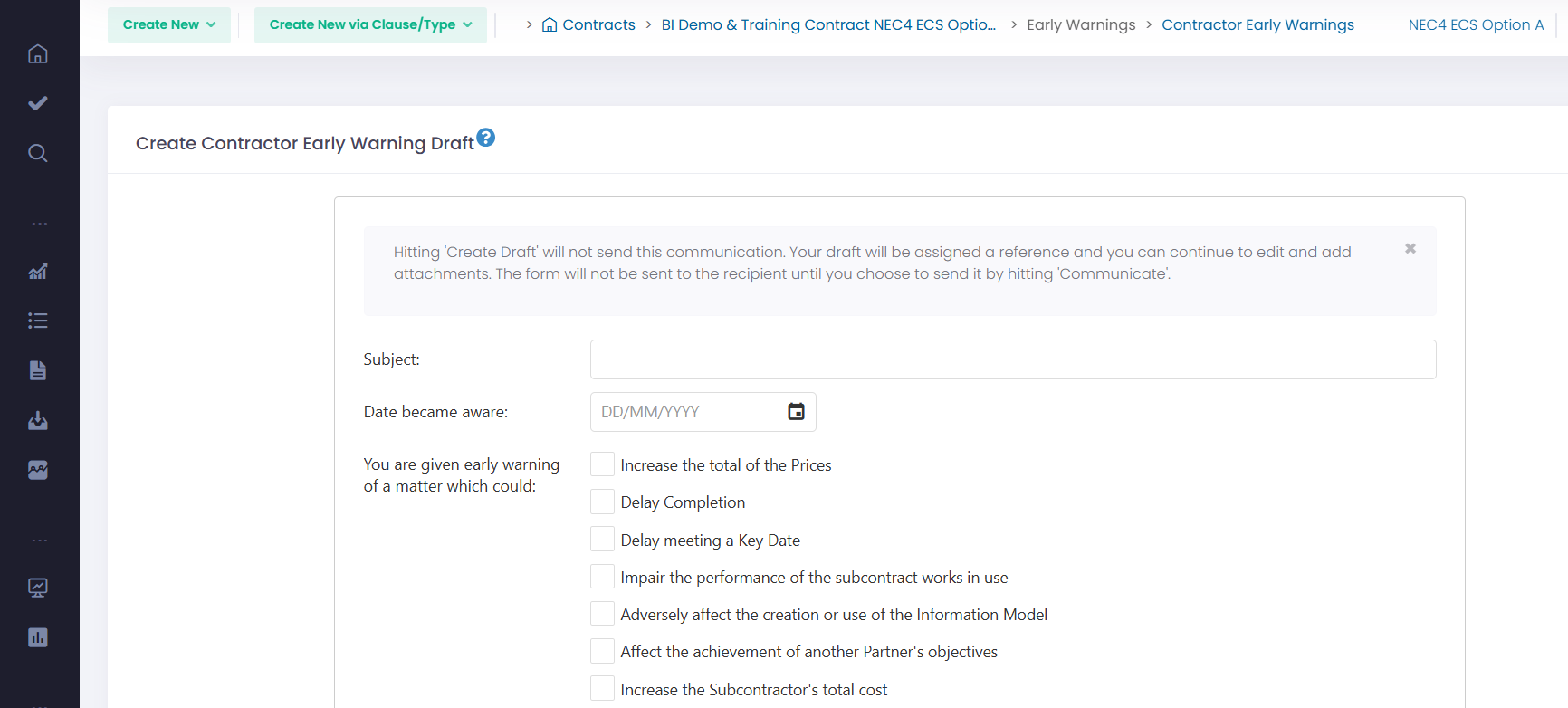
An short example from FastDraft of the level of detail needed for an Early Warning notice.
This is the point most frequently overlooked in practice, and it carries a direct commercial consequence.
Where the Project Manager states in the instruction to submit quotations that the Contractor did not give an early warning of a matter that an experienced contractor could have given, the Compensation Event is assessed as if the Contractor had given that early warning. In practice, this can reduce the assessment to reflect what the impact would have been had the matter been raised and managed earlier.
On cost-based options, failure to give an early warning may also have cost consequences in some cases.
The message is straightforward. Failing to notify is not a neutral act. It can directly affect recovery.
- Raising early warnings too late
Treating the early warning process as a retrospective exercise is the most frequent mistake. A notice issued after the impact has already occurred serves little practical purpose and may affect entitlement.
Solution: Notify as soon as the risk becomes apparent, not once it has already become a problem.
- Confusing early warnings with Compensation Event notifications
Raising an early warning does not notify a Compensation Event. Both obligations exist independently and both must be met within their respective timeframes.
Solution: Maintain a clear distinction between the risk management process and the change management process. Treat them as separate disciplines with separate deadlines.
- Using RFIs or TQs as a substitute for early warnings
Requests for Information and Technical Queries are not early warnings. Where a matter raised through an RFI or TQ is becoming urgent or may affect time or cost, a separate early warning should be issued.
Solution: Review all live RFIs and TQs regularly. Where any has a potential time or cost implication, raise an early warning without delay.
- Treating the Early Warning Register as a blame log
Where the Early Warning Register is used as a defensive or adversarial tool, the collaborative purpose of the process is lost and the project suffers.
Solution: Keep the focus on actions, decisions, and outcomes. The Early Warning Register should answer what needs to happen next, not who is responsible for what has already gone wrong.
- Allowing the Early Warning Register to go stale
An Early Warning Register that is not regularly reviewed and updated ceases to function as a management tool.
Solution: Review the Early Warning Register at every early warning meeting. Close matters that have been resolved. Add new matters promptly.
Worked Example: Late Materials Order
On one project, a Contractor became aware that a key materials order would be significantly delayed due to a supply chain disruption outside its control. Rather than raising an early warning, the Contractor chose to manage the situation internally and hope the position improved.
It did not. By the time the delay was formally notified, the programme had already slipped and the Client had made commitments to third parties based on the original Completion Date. Alternative suppliers could have been explored. Works could have been resequenced. Those options existed early on. By the time the Contractor notified, they had gone.
When the Compensation Event was assessed, it was assessed on the basis of what would have happened had the early warning been given when it should have been. The recovery was reduced accordingly.
The dispute that followed was not really about the materials delay. It was about a conversation that should have happened in week three happening in week eleven. Raise it early. The contract, and the project, work better when you do.
Take your NEC4 Early Warning Health Check
Configuration Risk in NEC Management: Lessons from United Utilities v Northstone
Contract management software should reduce risk, not create new arguments about what the contract requires. A recent Technology and Construction Court decision, United Utilities Water Ltd v Northstone (NI) Ltd t/a Farrans Construction [2026] EWHC 1057 (TCC), is a useful reminder of a practical problem many NEC users will recognise: what happens when the contract is amended, but the contract management platform is not updated to match? The case did not decide that an automatically generated platform date invalidated a payment notice. Nor did it decide that the platform caused the dispute. But it does highlight a wider risk pattern: if the live contract, system configuration and project team practice diverge, parties may later find themselves arguing about dates, notices, permissions,...

Introducing the Public Works Academy
Mastering Public Works Contracts: A Smarter Way to Build Capability Across Your Team In today’s construction landscape, understanding contract frameworks isn’t just beneficial; it’s essential. Nowhere is this more apparent than in Ireland, where Public Works Contracts (PWCs) form the mandatory foundation for delivering publicly funded infrastructure projects. Yet, for many professionals, navigating these contracts can feel complex, technical, and at times overwhelming. That’s exactly where the Public Works Contract (PWC) Academy comes in. Why Public Works Contracts Matter Public Works Contracts sit at the heart of Ireland’s Capital Works Management Framework (CWMF), governing how public projects are procured, managed, and delivered. A solid understanding of...

Why I Joined Built Intelligence and What I’ll Be Writing About
Genna Rourke joined Built Intelligence as Industry Engagement Director in January 2026. With nearly twenty years’ experience across quantity surveying and commercial leadership, Genna brings first-hand industry perspective to our work across FastDraft, Academy and wider thought leadership. In this new series, she will share practical views on the challenges construction teams face in contract management, capability development and commercial control. Hello. Here’s who I am and why I’m writing. I joined Built Intelligence in January 2026 as Industry Engagement Director. Before that, I spent nearly twenty years working as a quantity surveyor and commercial leader across infrastructure, civil engineering and contractor environments. I am a Chartered QS, MRICS and FCInstCES,...